Car Window Tinting Guide
The Complete Guide to Car Window Tinting in Dubai: Brands, Installation, Legal Limits, and Maintenance
Driving in the UAE involves constant exposure to sunlight, heat, and glare. Window tinting improves comfort, protects interiors, and enhances visibility in bright conditions. It reduces cabin temperature, blocks harmful UV rays, and decreases eye strain. A suitable film can also increase energy efficiency by lowering air-conditioning use.
This complete guide explains car window tinting in Dubai and across the UAE, including tinting laws, film technologies, major brands, installation standards, and maintenance practices. Whether your vehicle operates in heavy traffic or long highway routes, this guide outlines what performs best under UAE conditions while remaining compliant with local regulations.
Quick Overview: What Window Tint Does for a Car
Window tint film is a thin laminate applied to glass to alter light and heat transmission. A professionally installed film provides the following benefits:
Reduces interior temperature and overall heat buildup.
Blocks up to 99 percent of UV radiation, protecting occupants and interior materials.
Reduces glare and improves visual comfort.
Increases privacy while controlling visible light transmission (VLT).
Enhances appearance while maintaining outward visibility.
Legal Framework: VLT Limits and Compliance in Dubai
Understanding VLT (Visible Light Transmission) and local tinting regulations is essential before installation. Dubai has strict compliance standards enforced by RTA and law enforcement authorities.
Key legal VLT limits for Dubai and UAE:
Front windshield: Must remain clear; a top strip up to 15 cm is allowed.
Front side windows: Minimum 70% VLT (maximum 30% darkness).
Rear side windows: Minimum 50% VLT (maximum 50% darkness).
Rear windshield: Minimum 30% VLT (up to 70% darkness permitted for privacy).
Consequences for non-compliance:
Fines typically start from AED 1,500 per violation.
Possible vehicle impoundment in serious cases.
Points on the driving license or registration issues.
Insurance complications if an accident involves non-compliant tint.
Special permissions:
Medical exemptions are possible with supporting documents approved through RTA or Dubai Police. Authorization must always be carried when driving.
Types of Window Tint Films and Their Performance in Dubai
Choosing the right film begins with understanding film construction and durability in high-heat environments.
Dyed Films
Uses carbon-based dye to absorb light and reduce glare.
Heat rejection: 35–40 percent.
UV protection: Low to moderate.
Durability: Limited; tends to fade or discolor over time.
Signal interference: None.
Recommended for: Short-term or aesthetic purposes.
Suitability for Dubai: Limited, due to strong UV and heat exposure.
Metalized Films
Incorporates metal oxides to reflect heat.
Heat rejection: 50–60 percent.
UV protection: Moderate.
Durability: Good scratch resistance.
Signal interference: Possible with GPS, radio, or mobile signals.
Recommended for: Effective heat reflection in older vehicles.
Suitability for Dubai: Practical but not ideal for vehicles requiring strong electronic connectivity.
Carbon Films
Uses carbon particles to absorb infrared radiation.
Heat rejection: 50–65 percent.
UV protection: Up to 99 percent.
Durability: Excellent; color remains stable.
Signal interference: None.
Recommended for: Balanced performance and reliability.
Suitability for Dubai: Strong value choice for sustained heat and UV control.
Ceramic (Nano-Ceramic) Films
Built using ceramic nanoparticles to block heat and infrared radiation.
Heat rejection: 70 percent or higher.
UV protection: 99 percent.
Durability: Very high; retains clarity and color.
Signal interference: None.
Recommended for: Long-term protection and premium heat control.
Suitability for Dubai: Most effective option for comfort and temperature management.
Brand Insights: Leading Tint Technologies for Dubai
Selecting a reputable brand ensures clarity, durability, and stable performance under heat. The following tinting brands are commonly applied across Dubai, each offering unique advantages for local driving conditions.
3M Window Films (FX, CS, IR, CR Series)
3M’s window tinting films are widely trusted for consistent optical clarity and long-term stability in desert climates. The FX and CS series provide balanced UV and heat protection, while IR and CR Ceramic films use nano-ceramic materials for advanced infrared rejection.
Key strengths include:

High infrared and UV protection (up to 99 percent).
Durable construction with minimal color shift.
Reduced glare with high visible clarity.
These films are suited for vehicle owners seeking reliable performance, long-term comfort, and compliance with Dubai’s tinting regulations. They perform well under continuous sunlight, maintaining cabin comfort and interior longevity.
Armolan Films (Ceramic HP, IRX, HP Onyx)
Armolan produces durable tint films designed for high-heat environments. The Ceramic HP, IRX, and HP Onyx series offer superior heat rejection through multi-layer ceramic construction.
Key strengths include:
High IR and UV blocking capacity suitable for the UAE climate.
Enhanced clarity with low reflectivity.
Strong adhesive stability that supports long-term use.
Armolan films balance protection and visibility, providing dependable temperature control for drivers who spend extended hours on the road. Their heat-resistant structure and optical consistency make them practical for Dubai’s demanding weather.
3M, Armolan, and Similar Technologies in Context
In professional tinting practice, nano-ceramic and hybrid films like these form the foundation of high-performance installations in Dubai. They provide measurable reductions in cabin temperature while maintaining legal VLT transparency.
LLumar Window Films (CTX, IRX, Pinnacle)
LLumar’s ceramic range focuses on infrared blocking and signal-friendly performance. The CTX and IRX series offer UV rejection and durable optical clarity suitable for the UAE climate.
Key strengths:
High heat rejection without metallic layers.
Excellent clarity and long-term adhesion.
Balanced cost-to-performance options.
XPEL (Prime XR, Nano-Ceramic Series)
XPEL films provide high infrared rejection and visual clarity. The Prime XR range is known for its color stability and strong heat reduction in extreme conditions.
Key strengths:
Up to 98 percent infrared heat rejection.
Signal-safe construction with UV filtering.
Lifetime warranty options from certified installers.
V-KOOL (XIR Gold Sputter Technology)
V-KOOL’s XIR Gold Sputter technology reflects infrared heat effectively while maintaining light transparency. It is widely used in regions with high UV intensity such as the UAE.
Key strengths:
Infrared reflection up to 95 percent.
Stable color tone and high clarity.
Suitable for drivers seeking strong heat management without dark shades.
Other Notable Brands: SunTek, Huper Optik, Rayno, Johnson, and Union Films
These brands include specialized ceramic and titanium-based technologies tailored for desert regions.
SunTek and Huper Optik emphasize infrared and UV blocking with stable optical performance.
Rayno features hybrid nano carbon-ceramic formulations.
Johnson films focus on UV safety and fade resistance.
Each brand provides heat rejection efficiency and material stability that align well with Dubai’s driving conditions.
Installation Process: What Professional Tinting Involves
Professional tinting requires technical precision and controlled conditions.
Pre-installation:
Confirming VLT selection and local compliance.
Deep glass cleaning to remove all debris.
Inspection for scratches or factory tints.
Cutting and Preparation:
Pre-cutting or computer-guided film shaping.
Application fluid preparation for proper positioning.
Application:
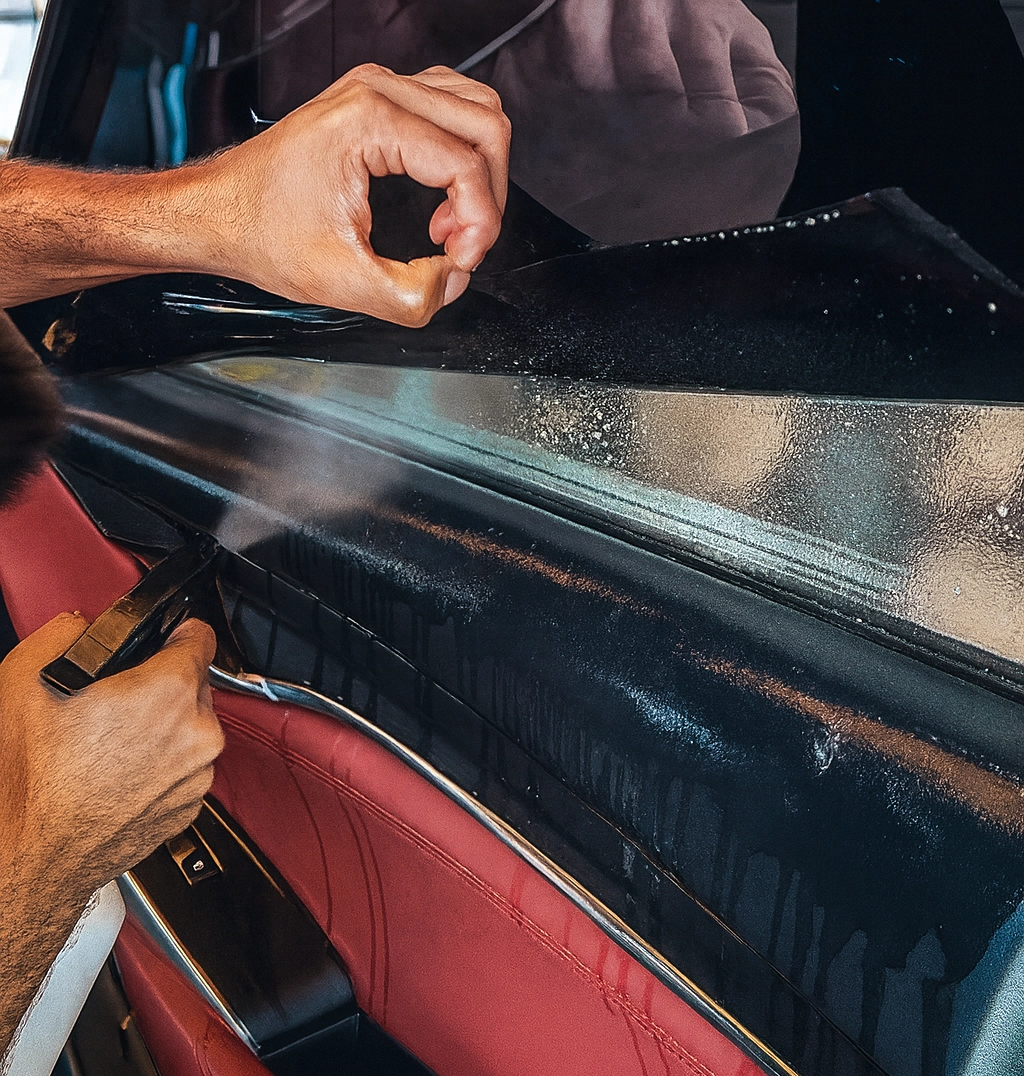
Wet installation with squeegees to prevent bubbles.
Trimming edges for accurate fit.
Heat curing for film adhesion.
Final Checks:
Visual inspection and finishing adjustments.
Guidance for curing and first-use instructions.
Why professional installation matters:
Controlled environments prevent dust contamination, ensure even adhesion, and maintain warranty validity. Proper installation enhances both heat rejection and visual uniformity, preserving film life and performance.
Post-Installation Care and Maintenance
Following proper care procedures extends the film’s life and effectiveness.
Immediate Curing Period:
Keep windows rolled up for 3–7 days.
Avoid moisture exposure during curing.
Prevent contact with sand or construction dust.
Regular Maintenance:
Clean using pH-neutral shampoo and microfiber cloths.
Avoid harsh detergents and abrasive materials.
Remove bird droppings or sap promptly.
Periodic Service:
Schedule inspection every 6–12 months.
Check for edge lifting or wear.
Use ceramic-friendly sealants if advised by the manufacturer.
Nano-ceramic films such as 3M IR/CR and Armolan IRX retain optical quality with minimal care when cleaned with non-abrasive tools.
Expected Lifespan, Warranties, and Costs
Film lifespan depends on material quality, exposure conditions, and maintenance.
Dyed films: 1–5 years with limited color retention.
Metalized films: 3–7 years with moderate stability.
Carbon films: 5–10 years with strong UV defense.
Nano-ceramic films: Up to a decade with consistent clarity and performance.
Premium manufacturers provide multi-year or lifetime warranties when installed by authorized technicians. Warranty coverage often requires proper installation documentation and periodic inspection.
Cost and Value Guide
Tinting costs vary by film type, vehicle size, and installation standard. Nano-ceramic and sputtered films generally carry higher pricing due to advanced materials and extended durability.
For assistance in identifying the correct tint and understanding current pricing, contact SuperQuick Detailers. Our team can recommend film options suited to your vehicle type, legal compliance requirements, and long-term maintenance preferences.
Final Recommendations
Selecting the right window tint involves balancing legal limits, heat resistance, and visual comfort. Nano-ceramic and carbon-based films perform reliably in Dubai’s conditions, offering long-term clarity and thermal stability. Sputtered and multi-layered films provide enhanced infrared reflection for those seeking maximum cabin cooling.
SuperQuick Detailers offers certified nano-ceramic installations using advanced film technologies such as 3M FX, CS, IR, CR and Armolan Ceramic HP, IRX, HP Onyx. Technicians evaluate vehicle glass, confirm VLT compliance, and guide clients through the selection process before installation.
The result is durable, compliant, and thermally efficient window tinting tailored for UAE driving environments. For consultation or film recommendations, contact SuperQuick Detailers for expert guidance and professional-grade installation.
